Part 3 of Unplugged and Reconnected – Think of your brain’s talents like your new favorite app
If there was an app that could make memories for you, complete with a personalized soundtrack and live-streaming videos – would you use it with pure delight?
If there was an app that could project that grocery list you left on the kitchen counter magically appear in your hands as you stood in aisle 5, would you feel like you had a grocery genie at your disposal?
If there was an app that could consolidate all that you learned throughout the day, delete unnecessary junk data, and cross-reference experiences and insight – would you be opening that app and watching the magic consolation happen with a sense of wonder?
I have remarkable good news for you — you already have these incredible apps at your disposal. These are just a sampling of the many features of your most phenomenal brain.
The very best way to access these “apps” is put away your phone.
I want to invite you to tag along with me on a trip down memory lane that I took just last night. As you get ready to join me, I have to share with you that this virtual experience was neatly filed in my memory banks, instantly retrieved and came to life in every fiber of my being. It was all made possible without any technology or iCloud storage. Can you even wrap your head around that?
I tapped the on switch to the Bose speaker resting on kitchen counter. It synched instantaneously with a 28 year old playlist. In a split second I was transported back in time, to a kitchen in small townhouse 2,800 miles across the country, had Benjamin-buttoned myself back to age 46 and was laughing and dancing with the love of my life, who has been gone from this earth for 24 years. A melodious song magically dropped me right back into a memory so visceral I felt I was actually living it all over again. But this time, I was keenly aware that this moment in time was priceless – and I savored every feeling that bubbled up in my body, every emotion that was coursing through me as I relieved this magic moment.
Ironically, the song that was my ticket to ride this magical carpet back in time was This Magic Moment by Jay and the Americans, which I had first heard back in 1968 – when I was just 16.
For the next 20 minutes, I danced across the kitchen floor in stockinged feet with my gregarious husband smiling back at me and twirling me around with that playfulness I treasured. An ordinary Tuesday evening, with dinner simmering on the stove, our long commutes and hectic workdays behind us – and just this magical moment of being.
There is no app that could ever produce such a wonder. Back in the day when that core memory was made, we danced to that song on a CD in a small boom box in the dining room. No videos, no photos, no tangible evidence that it even happened.
That priceless memory cannot be erased, faded or challenged. However, it can be called up, relived and enriched as many times as I need it to be. How magical is that?
What I know for sure is that long before we could capture the present moment in a video on our phones, I already had access to such technology. It was in my brain’s remarkable capacity to create, store and recall vivid memories.
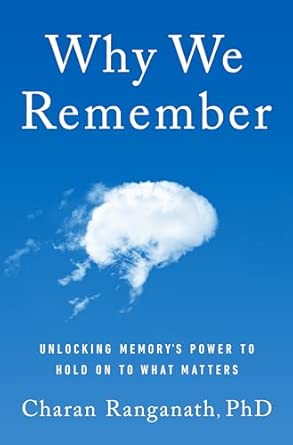
In his book, Why We Remember, Dr. Charan Ranganath, reveals how our memory has the power to hold on to what matters most to us. I confess that when I consumed his book a few years ago, I was mesmerized and transfixed. I developed a deep appreciation and respect for what my brain was capable of — and for the way it had already captured 7 decades of my life without any modern technology whatsoever.
I learned a few more things about my brain as I turned the pages of that book. I discovered that when I would role-play in my head how I would navigate my upcoming flight across the country to visit my son that this wasn’t just a quirk of mine (as my daughter liked to tease me it was) — it was an integral part of planning and being prepared for unexpected turns of events. What my daughter believed was a quirk was actually a feature — and one that served me well.
Imagine if you had an app on your phone, where you plugged in your trip details and a little video would be created with three possible scenarios.
- The first would be everything going according to plan. That video would have up tempo music and smiling faces.
- The second would be a flight delay, and would highlight available options. Door number 1 would be grabbing some lunch while you wait; Door number 2 would be switching airlines and catching a different flight; Door number 3 would be renting a car and driving to your destination.
- That third possible scenario would be missing the connecting flight or lost luggage. Several options would also magically appear for resolving these possible problems.
I will let you in on a rather unbelievable secret: your brain can process and provide all this simulation to you in less time than it took me to compose and type it!
For those taking notes, it is this very same app-like wizardry that you can apply to remember the grocery list you often forget. Dr. Ranganath uses this simple practice regularly. He spends a few minutes imagining himself walking through the grocery store, aisle by aisle and placing the items on his list in the cart. This simple visualization practice helps him instantly recall his list even when it is at home on the counter and he is in the middle of Whole Foods.
By the way – it is this powerful visualization practice that our Olympic athletes use as a superpower just before they jettison themselves down those snow-packed ski slopes racing for a gold medal. It is not an app, it is using their brain power to execute and believe in their plan.
You may be wondering now about that app that takes all the data and experiences that you’ve gathered throughout the day and does the tidying up job. You may even be wishing you had an app or robot that could do that for your house. Well, that magic brain application comes in the form of — sleep.
Mic drop!
You do nothing. You simply power down and sleep, deeply and soundly. Your brain does some of its most profound work while you are resting. Now that is an app you likely would pay plenty to have.
It is while we are sleeping that our brain goes through the “car wash” and cleans up superfluous junk we don’t really, cluttering up the place, and it also not only neatly files away what is important – it cross references it in ways we cannot begin to imagine. Until we need to re-imagine or repurpose past experiences, knowledge we gained but have long forgotten, and problem solve for the present moment.
This is why sleep hygiene is so important. If we aren’t actually proactively setting ourselves up for success, this magical processing will not operate at maximum efficiency. You’ll recall that not engaging with your phone for an hour prior to bedtime is now highly recommended. Now you know why. You want that magic app in your brain to do its job, while you are sleeping.
Let’s just take a moment to re-imagine what a detox from our phones actually does for us. The benefits far outweigh any short-lived dopamine hits you crave.
- When you are fully present in what seem like ordinary moments in your life, you actually are creating lasting memories, available for instant recall and reliving in technicolor, without the need for iCloud storage. Magic moments you can call up anytime, anywhere, throughout your lifetime.
- When you use visualization for a grocery list, a trip, an interaction at work, a challenge you’ve given yourself — you are developing a superpower and building neuroplasticity in your personal processor (your brain).
- When you take your sleep hygiene seriously, your brain will do the work of sorting, storing and deleting, without any noticeable effort on your part. What you will notice however is how quickly you can assimilate what you need when a problem, opportunity or turn of events arises during your busy day.
Here’s what I suspect might happen today now that you’ve read this. You are likely to look at your phone and be much less amazed by the array of apps. You’ll start to appreciate and harness your customized brain power!
Noteworthy Resources:
Check out Dr. Ranganath’s book Why We Remember and listen to him with Andrew Huberman on the Huberman Lab podcast: How to Improve Memory and Focus